ASLH Letter regarding closure of San Francisco/San Bruno, CA, and Chicago, IL, NARA sites
September 30, 2026
Dr. Bradford Wilson
Archivist of the United States
National Archives and Records Administration
8601 Adelphi Road
College Park, MD 20740-6001
Dear Dr. Wilson:
In July 2026, the National Archives and Records Administration announced that it will be closing its branches at San Francisco/San Bruno, CA and Chicago, IL. NARA cites financial considerations (upkeep of buildings) and lack of space for its reasons in closing these facilities. In August 2026, NARA announced that it will be splitting the collections up to be housed at different branches (Riverside, Denver, College Park, Fort Worth, Kansas City, Boston, Fort Worth, Atlanta).
These proposed closures and dispersals are deeply concerning. NARA San Francisco/San Bruno contain invaluable records from California, Nevada, Hawaii, American Samoa, and the Pacific Territories. They include materials relating to the enforcement of Chinese exclusion and other immigration laws, naturalization records, the case files of the local federal courts, the U.S. role in the Pacific, the history of Hawaii and Samoa, genealogical records, US military operations in the Pacific, the Bureau of Indian Affairs records for California tribes, and more. NARA Chicago contains records from Illinois, Indiana, Michigan, Minnesota, Ohio, and Wisconsin and includes rich material about the federal courts, the Bureau of Indian Affairs, the Immigration and Naturalization Service, and the Coast Guard.
As the principal organization representing legal historians in the United States, we are seriously alarmed for the following reasons:
Dividing collections that cohere geographically and spreading them to disparate NARA facilities is unwise. It makes more sense to keep records concerning the region together.
Making collections less accessible to local communities and scholars means that these users will often have to travel further to access records held in disparate facilities.
There is no assurance that these records will be available to researchers, as opposed to being kept at storage-only sites.
Most of these records are not digitized and are only available as paper records.
These closures will result in the loss of knowledge of local NARA branch staff who have extensive experience with the collections.
The changes are also likely to produce extensive delays for researchers in accessing information as records are transferred and rehoused.
We therefore urge you not to close these facilities that are so essential to public knowledge of, and research in, American legal history. Please let us know if we can answer any questions.
Thank you for your attention to this important matter.
Committee on Documentary Preservation, American Society for Legal History (Peter Reich, Chair, Jody Butterworth, Ryan Greenfield)
ASLH Letter regarding destruction of personnel records at Travis Air Force Base
February 28, 2025
Laurence Brewer
Chief Records Office
National Archives and Records Administration
cc: Hannah Bergman, Acting General Counsel, NARA
Dear Mr. Brewer:
On behalf of the American Society for Legal History (ASLH), the Society’s Committee on Documentary Preservation objects strenuously to the destruction of veterans’ Vietnam-era flight records at Travis Air Force Base, Fairfield, California.
It has come to our attention that flight records for 750,000 veterans, potential claimants who could benefit from an Agent Orange class action lawsuit, have been, or are scheduled to be destroyed. This litigation terminated with a Final Stipulation and Order in Nehmer v. United States Department of Veterans Affairs, No. CV-86-6160 (N.D. Cal., Nov. 5, 2020), which required the U.S. government to identify exposed individuals and grant disability and death benefits where appropriate. These flight records could potentially constitute proof that such individuals served in Vietnam, so may have been exposed to Agent Orange and suffered significant health injuries. This identification and compensation process is still ongoing.
Regardless of the resolution of particular claims, identifying particular individuals who may have suffered injury in Vietnam is of great importance for future historians of wartime legal redress against the U.S. government. Information about the numbers and characteristics of injured veterans is crucial for understanding a period when the military’s legal responsibility for personnel health conditions was, and continues to be, highly contested.
Therefore, the American Society for Legal History requests that any existing flight records at Travis Air Force Base be preserved and made accessible to the public where not classified.
Thank you for your consideration,
Committee on Documentary Preservation, American Society for Legal History
Barbara Y. Welke, Distinguished McKnight University Professor & Professor of History and Law, University of Minnesota and Kenneth Ledford, Associate Professor of History and Law, Case Western Reserve University 2010 ASLH Program Committee Co-Chairs
Updated by Sophia Z. Lee, Professor of Law, University of Pennsylvania and Fahad Ahmad Bishara, Associate Professor of History, University of Virginia 2022 ASLH Program Committee Co-Chairs
Last updated December 2023
In 2008, Linda Kerber published three short articles titled “Conference Rules” that offered sage advice on presenting a paper, commenting, and chairing. (The AHA reprinted the articles in the May, September, and October issues of Perspectives; we have included links to these wonderful articles at the end of our advice.) Our goal is to offer some advice on another crucial element of presenting at a professional academic conference: putting together a conference proposal. Our advice is tailored with the ASLH in mind but applies to many other conferences as well.
Point #1 Learn Something About the Organization. It is helpful, as a starting point, to know something about the organization and the annual meeting at which you hope to present. Since the first time you attend a conference is often because you’re on the program, we offer here some background on the ASLH.
The ASLH is a membership organization dedicated to fostering scholarship, teaching, and study concerning the law and institutions of all legal systems, both Anglo-American and those that do not operate in the Anglo-American tradition. The ASLH holds its annual meeting in late October or November. The conference runs from Thursday evening through Saturday evening, with sessions on Friday and Saturday. ASLH meetings are relatively small (500 people) and welcoming.
All who attend the conference, including those on the program, need to register for the conference and pay the appropriate registration fee. In registering for the conference, registrants agree to conform to AHA standards for professional conduct adopted by the ASLH. We also ask that participants stay at the conference hotel if at all possible, as the ASLH has contractual room obligations it must meet to avoid penalties. Information about conference registration, hotel rooms, and travel will appear on the ASLH web page in early summer.
Assume that the conference will occur in person, without the ability to present remotely. The ASLH does not currently have the technological capacities or budget to host a hybrid or remote conference. Typically (that is, absent pandemic constraints), the conference includes open receptions with food and drink on Thursday, Friday, and Saturday evenings that most people coming to the conference attend, as well as buffet breakfasts on Friday and Saturday morning before sessions begin, and a lunch on Saturday at which awards are given. All this food and socializing means that there are lots of opportunities to mix, mingle, and meet new folks.
These structured socializing opportunities, along with the quality of the panels, mean that attendance at sessions is high whether you find yourself on the first session on Friday morning or the last on Saturday afternoon. There are no panels on Sunday. There are generally six or seven sessions in each time slot and over 50 sessions in total. The session timeslots are 90 minutes long. The most traditional format for sessions is three papers with a chair and commentator, but every ASLH includes panels with alternative formats, including roundtables, author meets readers, and panels with a larger number of presenters (5 to 6) doing short papers (10 minutes) and no commentator. ASLH papers are presented orally, or alongside a handout that the presenter provides; there is no ability to show slides or powerpoint. Generally program committees are very open to alternative formats. What’s important is that the structure suit the panel’s purpose.
Two final important details about the annual meeting: the ASLH welcomes graduate students on the program and there is (limited) financial support for international scholars and graduate students who are on the program. If you are a graduate student, you should also consider whether you are eligible for the Kathryn T. Preyer Award. You might also consider applying to the Student Research Colloquium, which meets the Thursday the conference opens.
Point #2 Read the Call for Papers Carefully and Follow the Rules for Submission. Program committees volunteer their time and are sifting through many proposals. It is simply a matter of common sense to understand that you will maximize your chances of getting onto the program if you follow the rules for submission set out in the call for papers. This means submitting a proposal that meets all the requirements set out by the program committee, including format, details relating to deadline, length of paper abstracts, length of panel summary, and bios for panelists. In the interest of maximizing participation at the annual meeting, the ASLH has a strict one-appearance policy (excluding appearances at pre-conference events). Prospective participants may submit proposals for multiple sessions, with the understanding that the panel chair will be responsible for promptly finding an appropriate substitute member for any session from which a participant has to withdraw because they are on more than one accepted panel.
Point #3 Designing a Panel. There are many elements to a well-structured panel.
First, think about your audience. A well-constructed panel should both be structured to appeal to the audience at the particular conference and have appeal beyond a narrow subfield. Particularly for scholars working in smaller subfields, one way to broaden the potential audience for a panel (and thereby increase your chances of getting on the program in the first place) is to make the panel comparative in some way. This might mean structuring the panel to incorporate scholars working on similar questions in other geographic or chronological fields or scholars working in fields beyond history or law (e.g., sociology, anthropology, political science, legal practitioners).
Second, the goal of a conference presentation is to share your work-in-progress with a broader audience, get feedback on that work, and make connections with scholars interested in similar questions that can extend beyond the conference. Program committees look for panels that foster these goals. One way of putting this point is that you want to construct a panel that is diverse. Diversity takes a range of forms: representation by scholars of different rank (from graduate students to senior scholars), diverse institutions, and participants from groups historically under-represented in the organization and academia. Established scholars should consider including graduate students and junior scholars in their panels. If you’re a graduate student or an independent scholar, you will get more out of a conference session and maximize your chances of getting on the program in the first place by including others on your panel (presenters/commentator/chair) who are known through their previously published work in the field. Your advisor though should not be the commentator, no matter how well known they are in the field. Panels with multiple individuals from the same institution are far less likely to get on the program. The goal is for conference panels to generate new conversations that are otherwise challenging to hold across geographic and institutional divides.
The ASLH’s Graduate Student Outreach Committee (GSOC) is hosting a spreadsheet where authors in search of a panel can post about their papers and panels in search of members can find paper authors. While anyone can post on the spreadsheet, it should be a particularly useful resource for connecting graduate students, junior scholars, and independent scholars with panel organizers. Please note that this is a public document and any personal information posted there will be accessible to the public. In addition, senior scholars can post their availability to serve as a chair or commentator on a separate spreadsheet here.
Third, plan ahead. Constructing a good panel takes time. The deadline for submissions for the 2023 ASLH is March 17. Start now!
Point #4. Panel Construction Nuts and Bolts. There are several steps here. If this will be the first (or one of the first) time(s) you’ve presented at a conference, we’d recommend putting together a traditionally formatted panel with three papers, a commentator, and a chair. Because putting together a panel takes real work, you will find many overwhelmed folks who are delighted to be part of your enterprise because you have shouldered the heavy lifting.
Decide on a Topic. Your first task is to think about the general topic/question that you’d like to shape the panel around. This will likely relate to your work, but should be framed broadly enough to support a panel with multiple papers and attract an audience. A good place to start is by looking at a past program for the ASLH. You can find past conference programs here.
Begin thinking about a Commentator. Second, you should begin to think about who you would like to have comment on your work. You’ll need to hold off on contacting your first choice until you have put the core of the panel together and see who is most appropriate for the panel as it comes together, but you should have ideas.
Find other panelists. Third, you need to find other panelists. This is a key opportunity to build professional networks beyond your own institution. How do you go about this? Lots of possibilities here. Talk to others at your institution, including your advisor(s), for suggestions, consider a former student working on related questions from your institution who now teaches elsewhere, check dissertation abstracts and recent journal articles to identify scholars working on related questions, and contact friends at other institutions who might have suggestions. Don’t be afraid to reach out to more senior scholars even if you do not know them already, as they are just the kind of busy scholar who might be very happy to join your panel. GSOC’s spreadsheet (see Point 3) is another great place to find panelists, especially ones who can add diversity by rank to a panel of more senior scholars. You can also use social media, though since this is the least targeted approach you may want to include details about the conference (including dates and place) and explain the general topic for the panel. Remember, the papers need to fit together well to make a successful panel. Ideally, the papers add up to a whole that is greater than the sum of the panel’s parts, exemplifying a new approach to a subject, for instance, or placing the papers in a productive interdisciplinary or cross-field discussion.
Invite someone to comment. Once you have the panelists set (including abstracts for their papers), you are ready to contact your first choice to serve as commentator for the panel. It can seem like a scary thing to email someone you don’t know, but whose work you respect. (This applies to other panelists as well.) We say, dive in. You’ll likely find senior scholars who are supportive and interested in your work. Be sure your email notes the conference (including place and dates) and topic and title of the panel, the names of other presenters, who and where they are, and their paper titles and abstracts. Do not feel discouraged or rejected if someone turns you down. Everyone in this business has many demands on their time. If your first choice can’t do it, turn to your next choice. You can also ask anyone who declines for suggestions of other scholars to try. If someone you invited to present a paper declined because they did not have a paper and they fit the commentator criteria, consider asking them to comment.
Invite someone to chair. The chair is a vital member of a panel and like the commentator should be an established scholar in the field(s) to which your panel relates. The chair handles introductions, keeps track of time to ensure that all panel participants get their fair share of time, sets the tone of the panel and guides the discussion that follows. These are crucial tasks. That said, it is fine to have the one person serve as chair and commentator.
Draft abstracts for your paper & panel. Panels that speak to a broad audience and panel/paper abstracts that communicate their significance to legal historians who do not specialize in your subfield will be most successful. Make sure to explain what’s new about your paper/panel and why it’s important. Most members of the program committee won’t be up to date on your area of research, so help them out by indicating what gap in the scholarship your work fills, what scholarly literature your argument challenges, or how you’re drawing on new sources. The panel proposal need not summarize all the papers—the paper abstracts will do that work. Instead, it should focus on the panel’s larger theme(s) and the benefits of bringing these papers together. Explain what scholarly conversations and contributions will result and why they are exciting. If the panel brings scholars together across rank, subfields, geographies, or temporalities, you can highlight that in the abstract, as well as the benefits of doing so.
Following through. If you’ve initiated things, you’re the one who will have to see it through – that is collect abstracts and CVs and get everything submitted in the proper format to the program committee on time. Submissions have to be made online using this page. Just in case, you’ll want to leave time in advance of the proposal deadline to resolve any technical problems. This all takes time and work, but what you’re doing here is beginning to construct the kinds of collegial networks that can then continue for years.
Save the dates. All members of your panel should plan to be available on both the Friday and Saturday of the Annual Meeting, because (with rare exceptions) ASLH cannot accommodate special scheduling requests.
Point #5 Conducting a Successful Panel. Finally, there’s the conference itself. We cannot do better than to refer you to Linda Kerber’s knowledgeable advice reprinted in AHA, Perspectives, May, September, and October 2008:
We look forward to seeing the wonderful panels you construct!
The ASLH Program Committee
ASLH Funded Projects, 2022
The ASLH Projects and Proposals committee (chaired by Sara Mayeux, Vanderbilt) has announced support for three projects. Please join us in offering thanks to the committee members, and congratulations to the recipients.
Hardeep Dhillon and Maddalena Marinari, “Illustrating Law: America’s Immigrants and the Struggle for U.S. Citizenship.”Illustrating Law proposes to create a graphic novel and website to accompany a special issue on the sociolegal history of U.S. citizenship and immigration during the long twentieth century, which the applicants are co-editing for the Journal of American Ethnic History.
Cynthia Farid et al., “The Making of Minorities in South Asia: Future Directions for History and Pedagogy.”The Making of Minorities convenes an international workshop, publish an edited volume, and develop an accompanying podcast about the issue of minority rights in South Asian legal history.
Dennis J. Wieboldt III, “Boston-Area Legal History Roundtable.” The Roundtable proposes to run a workshop series for graduate students working on legal history topics, and to build community among junior scholars whose networks were underdeveloped because of the Covid-19 pandemic.
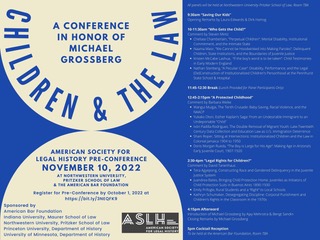
Those attending the upcoming ASLH conference should consider attending the pre-conference, “Children and the Law: A Conference in Honor of Michael Grossberg” at Northwestern University Pritzker School of Law and the American Bar Foundation on November 10 from 9:30am to 6pm. We will celebrate the important contributions of former ASLH President, Michael Grossberg, with three panels of pathbreaking scholarship on the field of children and the law.
We are requesting those that plan to attend register by October 1 [at this link: https://bit.ly/3NEQFK9]. This is a separate registration from the ASLH Conference registration that will enable the conveners to ensure there is adequate space for attendees at the panel and end-of-day reception.
The pre-conference is made possible by the generous support of the American Bar Foundation, Indiana University, Maurer School of Law, Northwestern University, Pritzker School of Law, Princeton University, Department of History, and the University of Minnesota, Department of History.
—
(All panels will take place at Northwestern Pritzker School of Law, Room LM 101 – Lincoln Hall, receptions will take place in the Faculty Commons)
—
9:30am “Saving Our Kids”
Opening Remarks by Laura Edwards & Dirk Hartog
10-11:30am “Who Gets the Child?”
Comment by Steven Mintz
Chelsea Chamberlain, “Perpetual Children”: Mental Disability, Institutional Commitment, and the Intimate State
Naama Maor, “We Cannot be Hoodwinked into Making Paroles”: Delinquent Children, State Institutions, and the Boundaries of Juvenile Justice
Ivón Padilla-Rodríguez, The Double Removal of Migrant Youth: Late-Twentieth Century Data Collection and Education Law as U.S. Immigration Deterrence
Nathan Stenberg, “A Peculiar Case”: Disability, Performance, and the Legal (De)Construction of Institutionalized Children’s Personhood at the Pennhurst State School & Hospital
11:45-12:30 Break (Lunch Provided for Panel Participants Only)
12:45-2:15pm “A Protected Childhood”
Comment by Barbara Welke
Wangui Muigai, The Tenth Crusade: Baby-Saving, Racial Violence, and the NAACP
Yukako Otori, Esther Kaplan’s Saga: From an Undesirable Immigrant to an Undeportable “Child”
Shani Roper, Sitting at Intersections: Institutionalized Children and the Law in Colonial Jamaica 1904 to 1950
Doris Morgan Rueda, “The Boy is Large for His Age”: Making Age in Arizona’s Early Juvenile Court, 1907-1920
2:30-4pm “Legal Rights for Children?”
Comment by David Tanenhaus
Tera Agyepong, Constructing Race and Gendered Delinquency in the Juvenile Justice System
Juandrea Bates, Bringing Child Protection Home: Juveniles as Initiators of Child Protection Suits in Buenos Aires 1890-1930
Emily Prifogle, Rural Students and a “Right” to Local Schools
Kathryn Schumaker, Desegregating Discipline: Corporal Punishment and Children’s Rights in the Classroom in the 1970s
4:15pm Afterward
Introduction of Michael Grossberg by Ajay Mehrotra & Bengt Sandin Closing Remarks by Michael Grossberg
2021 Plenary Address
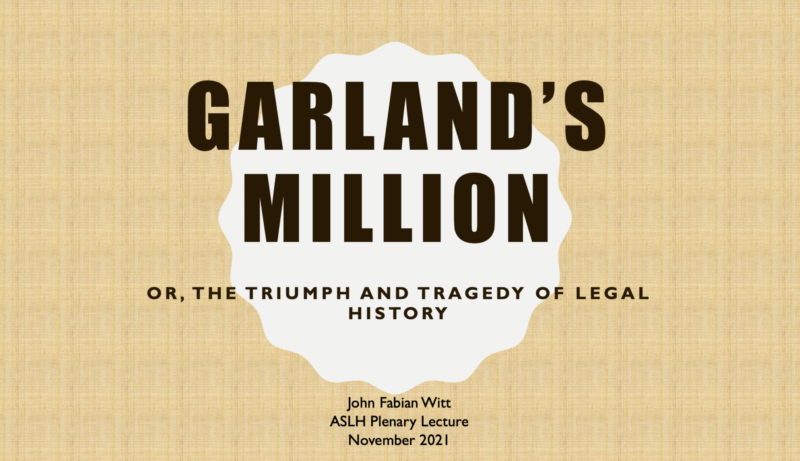
The plenary address at the Society’s 2021 annual meeting in New Orleans was given by John Fabian Witt, Allen H. Duffy Class of 1960 Professor of Law at Yale Law School, and entitled “Garland’s Million: The Tragedy and Triumph of Legal History.” The plenary was presented at Tulane University, and the Society is deeply grateful to Tulane University President Michael Fitts and Dean David Meyer (Tulane Law School) for their unflagging commitment to sponsoring this event.
John Fabian Witt is the author of a number of books, including American Contagions: Epidemics and the Law from Smallpox to COVID-19 and Lincoln’s Code: The Laws of War in American History, which was awarded the Bancroft Prize, was a finalist for the Pulitzer Prize, was selected for the American Bar Association’s Silver Gavel Award, and was a New York Times Notable Book. Professor Witt is currently writing the story of the men and women behind the Garland Fund: the 1920s foundation that quietly financed the efforts that culminated in Brown v. Board of Education.
The 2021 plenary address can be accessed in two ways:
You can watch the plenary here:
You can listen to the audio only here:
ASLH 2021 Election Results Announced
At the Saturday luncheon of the 2021 annual meeting in New Orleans, President Lauren Benton announced the results of the elections for the Board of Directors and Nominating Committee. The president-elect will serve a two-year term, members of the board of directors and nominating committees serve three-year terms.
Barbara Welke, University of Minnesota, President Elect
Elected to the Board of Directors:
Laura Edwards, Princeton University
Maggie Blackhawk, New York University
Michael Lobban, London School of Economics
Lucy Salyer, University of New Hampshire
Dan Hulsebosch, New York University
Elected to the Nominating Committee:
John Wertheimer, Davidson College
Nurfadzilah Yahaya, National University of Singapore
2019 Annual Meeting Prize, Honors, and Fellowship Winners
The ASLH is delighted to announce our 2019 prize, honors, and fellowship winners!
Cromwell Dissertation Prize
Winner: Jonathan Lande, “Disciplining Freedom: U.S. Army Slave Rebels and Emancipation During the Civil War”
At least since William Cooper Nell penned The Colored Patriots of the American Revolution in 1855, historians have linked African-American military service with manhood and citizenship. Black regiments in the Civil War have received considerable attention. Black service has rightly been deemed central to the North’s victory and an important step for both African-Americans’ assertion of sacrifice for and citizenship in the post-Civil War world. In his pathbreaking dissertation “Disciplining Freedom: U.S. Army Slave Rebels and Emancipation in the Civil War,” Jonathan Lande boldly argues that the conventional account is incomplete. Centering on the records of the courts martial and contextualizing them with administrative and personal sources, Lande uncovers deep northern anxiety about arming the formerly enslaved. Despite free labor ideological commitments, northern officers carried with them the albatross of slavery and white supremacy into courts martial proceedings against black soldiers. The courts martial produced minimalistic records, seemingly straightforward, and therefore deceptively equitable in their treatment of all soldiers, regardless of color. Lande’s textured reading of the records reveals them as sites of conflict. Far from being “schools” about the value of equal justice for the freedmen, these courts martial proceedings were means to discipline the formerly enslaved. For their part, freedmen continued on in their old traditions of resistance against oppression. Their experience of freedom and understanding of civic membership, Lande argues, was, in important ways, born of this struggle.
Cromwell Article Prize
Maggie Blackhawk, “Petitioning and the Making of the Administrative State,” 127 Yale Law Journal 1538 (2018)
“Petitioning and the Making of the Administrative State,” by Maggie McKinley–now Blackhawk–of the Penn Law School in the Yale Law Journal, makes a robust and compelling case that finds the constitutional basis of the administrative state in core republican ideals grounded in the First Amendment’s protection of the right to petition Congress for relief. The article combines exhaustive archival and empirical research with a deft handling of administrative law and judicial process to offer provocative interventions into much of our received wisdom in those fields.
This article, which runs to a hundred pages, is an ambitious and impressive undertaking whose impact can be best appreciated as two skillfully combined articles. The first is an empirical study grounded in the “North America Petitions Project,” an original dataset compiled by a group of which Blackhawk was a co-principal investigator. The project assembled a database of some 500,000 petitions submitted to Congress from the 1790s through 1950, offering “an extended longitudinal view of the petition process.” Second, the article is also a robust intervention into several ongoing historical and legal debates. Above all, it rejects criticisms of the modern administrative state as a violation of constitutional separation of powers and a usurpation of authority – even as unconstitutional – and challenges Chadha’s holding the legislative veto to be unconstitutional. A citation such as this cannot do justice to the many virtues of this article, which ranges over more than two centuries of American legal history while engaging areas of several lively constitutional dispute. It is a worthy choice for such an important award.
Cromwell Book Prize
Winner: Kimberly M. Welch, Black Litigants in the Antebellum American South (University of North Carolina Press, 2018)
Black Litigants is a tour de force of meticulous and arduous archival work, and the slow piecing together of documents to construct a nuanced, sophisticated and rich narrative. The work produces new historical knowledge regarding how free and enslaved black litigants in the antebellum South used local courts to make civil claims regarding debt, property, and contracts. Adding to this archival feat is how Welch writes with a strong and confident voice exploring what these cases tell us about law, race, and the slaveholding South.
Using local court documents from two parishes in Louisiana and two counties in Mississippi, Welsh constructs a detailed narrative of how some black people used courts to sue white people in local courts. The work incorporates and is in dialogue with other excellent scholarship on enslaved people who brought freedom suits. Yet where freedom suits had such significant consequences, Welch locates and analyzes more mundane and everyday claims. In fact, one of Welch’s central arguments is the very fact that such cases were unexceptional and that black plaintiffs won suits against whites on a regular basis. Welch carefully analyzes why this might be the case simultaneously recognizing the agency of black litigants, how law propped up and structured white supremacy, and how law was not hegemonic. Rather Black Litigants illustrates that judges, lawyers, and white people more generally had multiple competing interests and that, at least at times, ideas of property won out over, or at least co-existed with, ideas of white supremacy and slaveholding.
Welch provides a rich social history of local southern courts while also conveying a subtle and nuanced understanding of what law even is. She theorizes that law is a highly stylized language of claim making, a discourse, a way of shaping and telling stories that courts, lawyers, and others could recognize. Indeed, Welch herself provides us with new and significant stories that enhance our understanding of how local on-the-ground law operates and the spaces in which black litigants could assert their personhood, even citizenship, and partake in the public legal sphere.
The O Say Can You See Project merited the Dudziak Prize because it does more than merely put content online that could be digested in print form. Rather, it uses the internet platform to enable others to access 509 D.C. Circuit Court, Maryland state, and U.S. Supreme Court petitions for freedom. The creators have also modeled more than 55,000 relationships between the participants in these cases. They also included engaging essays by legal historians about these sources and the broader historical context. And, in 2018, the creators unveiled an 11-minute animated film, Anna, which has been widely used in secondary schools to teach students about the history of slavery and freedom. Overall, we were impressed by how this project harnessed the power of new media to excite the imaginations of current and future legal historians.
The Scottish Court of Sessions Digital Archive merited the Dudziak Prize because it is an ambitious multi-institutional effort to digitize Scottish sessions papers from the 1750s to 1840s, which are held by the University of Virginia Law Library and the Library of Congress. The project, which went public in 2018, consists of high-quality scans of approximately 10,000 documents, all expertly tagged using open source and exportable programming. These documents are especially valuable sources because they contain rich narratives of underrepresented groups in the British Atlantic world during the era of the American Revolution. This new archive should help facilitate research on women, enslaved persons, and laborers. Overall, we were impressed by the scholarly significance of this digital archive for the field of British Atlantic studies.
Honorary Fellows
Sally Falk Moore, Victor S. Thomas Professor of Anthropology Emerita at Harvard University and Affiliated Professor of International Legal Studies at Harvard Law School
Rebecca Scott, Charles Gibson Distinguished University Professor of History and Professor of Law at the University of Michigan
David Sugarman, Emeritus Professor of Law at the Law School of Lancaster University and Senior Associate Research Fellow at the Institute of Advanced Legal Studies, School of Advanced Studies, University of London
Craig Joyce Medal Recipient
Rayman Solomon, University Professor of Law and Dean Emeritus, Rutgers-Camden
John Phillip Reid Book Prize
Winner: Martha S. Jones, Birthright Citizens: A History of Race and Rights in Antebellum America (Cambridge University Press, 2018)
Deeply researched, beautifully crafted, and elegantly written, Birthright Citizens: A History of Race and Rights in Antebellum America upends traditional narratives of the development of citizenship. Martha Jones shows how African Americans used legal and political strategies to claim rights, connect them to citizenship, and solidify their status as Americans. The book is an exemplary recovery of bottom-up constitutional advocacy pursued not only through litigation and social movements, but also through the aspirations and practices of ordinary people. As Jones reminds us, the law of the United States has been shaped as much by its people as its legal professionals and elected officials.
Peter Gonville Stein Book Award
Winner: Khaled Fahmy, In Quest of Justice: Islamic Law and Forensic Medicine in Modern Egypt (University of California Press, 2018)
Exploring the intersection of law and medicine, In Quest of Justice masterfully rewrites the legal history of nineteenth-century Egypt. The book persuasively argues that legal reform in the modern Middle East was tied to the centralization of state power rather than efforts to adopt Western legal norms. Fahmy’s focus on the siyasa courts and their neglected documents corrects a historiographical bias towards privileging the history of shari‘a courts. While important, shari‘a courts were just one of many legal orders that existed in the Middle East in this period. Fahmy demonstrates that the siyasa courts are vital for our understanding of the legal transformations of the nineteenth century. The book moves seamlessly through background information, historiography, case studies, and new findings that revise the field.
Honorable Mention: Rohit De, A People’s Constitution: The Everyday Life of Law in the Indian Republic (Princeton University Press, 2018)
Surrency Article Prize
Catherine L. Evans, “Heart of Ice: Indigenous Defendants and Colonial Law in the Canadian North-West,” LHR 36: 2 (May 2018): 199-234
Catherine L. Evans’ essay offers a compelling account of a deeply eerie incident in the late nineteenth-century Canadian Northwest Territory, the killing of an older woman believed to be a wendigo (malevolent spirit) by three Cree men who were acting in accordance with Cree law, their subsequent criminal trial, and the balance struck between Cree and colonial law by colonial officials in mitigation. The article offers an extremely subtle assessment of legal pluralism on a colonial frontier by arguing that the trial of the wendigo killers must be incorporated with the better-known corpus of trials held in the aftermath of Louis Riel’s contemporaneous territorial “rebellion,” which displayed a completely different face of the colonial state. This memorable essay avoids easy answers without dismissing prior scholarship, exhibits excellent research, and demands that the reader consider deeply both the brutalities and the cracks in colonial law.
Sutherland Article Prize
Winner: Patrick Weil and Nicholas Handler, “Revocation of Citizenship and Rule of Law: How Judicial Review Defeated Britain’s First Denaturalization Regime,” LHR 36: 2 (May 2018): 295-354
Denaturalization, a policy which deprives subjects of their citizenship, originated in the United States (1906). Adopted by Britain via the Nationality and Status of Aliens Acts of 1914 and 1918, it fell out of use after the Second World War but remained on the statute books. While the power to revoke citizenship was not used at all between 1973 and 2000, in the past decade the Home Office has demonstrated a new willingness to apply the law, revoking the citizenship of ‘at least 373 individuals’ in that period. Weil and Handler’s article explores the history of denaturalization, considering both its decline and recent resurgence. They argue that a provision of the BNSA Act of 1918 created a system of judicial review for decisions made within the Home Office that limited and eventually extinguished the powers of that office where denaturalization was concerned. Legislative changes in 2002 replaced the committee-based review, which had served to protect individual rights, with a ‘significantly more deferential’ and often secretive form of oversight. Original in terms of both its primary sources and argument, Weil and Handler’s article also offers an intriguing take on the broader issue of national belonging which has garnered so much attention in recent years in Anglo-American scholarship.
Honorable Mention: Elizabeth Papp Kamali, “Trial by Ordeal by Jury in Medieval England, or Saints and Sinners in Literature and Law,” in Emotion, Violence, Vengeance and Law in the Middle Ages: Essays in Honour of William Ian Miller (Leiden: Brill, 2018)
Cromwell Fellowships
Cromwell Fellowships were awarded to the following recipients:
Michelle Bezark, PhD Candidate, Northwestern University: “’A Bill for Better Babies’: The Sheppard-Towner Act and Building a Modern Welfare State” Hardeep Dhillon, PhD Candidate, History, Harvard University: “Indians on the Move: Law, Borders, and Freedoms at the Turn of the Twentieth Century” Signe Fourmy, PhD Candidate, History, University of Texas at Austin: “They Chose Death Over Slavery: Enslaved Women and Infanticide in the Antebellum South” Jose Argueta Funes, JD, Yale Law School, PhD Candidate, Princeton University: “Past as Authority: Law, Property, and Reform in Hawai’i, 1840-1920” Jamie Grischkan, JD, University of Michigan Law School; PhD Candidate, History, Boston University: “Banking, Law, and American Liberalism: The Rise and Regulation of Bank Holding Companies in the Twentieth Century” Lauren van Haaften-Schick, PhD Candidate, Art History, Cornell University: “The Artist’s Reserved Rights Transfer and Sale Agreement: Origins and Afterlives in Art and Law” Amanda Kleintop, PhD, History, Northwestern University: “The Balance of Freedom: Abolishing Property Rights in Slaves after the US Civil War” David Korostyshevsky, PhD Candidate, History, University of Minnesota: “’Incapable of Managing His Estate’: Habitual Drunkenness and Guardianship Law in Nineteenth-Century America” Naama Maor, PhD Candidate, History, University of Chicago: “Delinquent Parents: Power and Responsibility in Progressive-Era Juvenile Justice” Bharath Palle, S.J.D. Candidate, Harvard Law School: “Wesley Hohfeld and the Struggle for a Legal Science” Natalie Shibley, PhD, History and Africana Studies, University of Pennsylvania: “Race, Homosexuality, and Military Justice, 1941-1993” Lila Teeters, PhD Candidate, History, University of New Hampshire: “Native Citizens: The Contest over U.S. Indigenous Citizenship, 1880-1924” Lael Weinberger, JD/PhD Candidate, History, University of Chicago: “The Politics of International Law in the United States, 1912-1954”
Kathryn T. Preyer Scholars Ofra Bloch, J.S.D. Candidate, Yale, “The Untold History of Israel’s Affirmative Action for Arab Citizens, 1946-1968” Brianna Lane Nofil, Ph.D. Candidate, Columbia, “‘Chinese Jails’ and the Birth of Immigration Detention for Profit, 1900-1905”
Mellon/ACLS Public Fellows Program – 2018 Fellowship Competition
The American Council of Learned Societies (“ACLS”) is pleased to announce the eighth annual competition of the Mellon/ACLS Public Fellows Program. This initiative places humanities PhDs in substantive roles in diverse nonprofit and government organizations, demonstrating that the knowledge and capacities developed in the course of earning a doctoral degree in the humanities have wide application beyond the academy. The fellowship carries an annual stipend of $67,500, health insurance coverage for the fellow, a relocation allowance, and up to $3,000 in professional development funds.
In 2018, ACLS will place up to 25 PhDs as Public Fellows in the following organizations and roles:
Center for Popular Democracy (Brooklyn, NY) – Strategic Research Associate
Chemical Heritage Foundation (Philadelphia, PA) – Digital Engagement Manager
Chicago Council on Global Affairs (Chicago, IL) – Research Associate, Global Cities
Consortium of Humanities Centers and Institutes (Madison, WI) – Global Programs Manager
Council of Independent Colleges (Washington, DC) – Development Officer
Environmental Law & Policy Center (Chicago, IL) – Senior Research Analyst, Transportation Innovation
Innocence Project (New York, NY) – Content Strategist
Lapham’s Quarterly (New York, NY) – Digital Producer
Los Angeles County Arts Commission (Los Angeles, CA) – Cross Sector Analyst
Los Angeles Review of Books (Los Angeles, CA) – Associate Executive Editor and Assistant Director, LARB Books
MinnPost (Minneapolis, MN) – Audience Development and Engagement Manager
The Moth (New York, NY) – Impact and Evaluation Officer
National Immigration Law Center (Washington, DC) – Research Program Manager
National Trust for Historic Preservation (Washington, DC) – Manager of Curatorial Innovation
PolicyLink (Oakland, CA) – Associate, Equitable Economy Research
Public Radio International (Minneapolis, MN) – Associate Editor, Global Nation
Race Forward (Oakland, CA or New York, NY) – Narrative Impact Analyst
Rockefeller Archive Center (Sleepy Hollow, NY) – Outreach Program Manager
Smithsonian Cultural Rescue Initiative (Washington, DC) – Program Manager for Cultural Disaster Analysis
Smithsonian Institution Office of International Relations (Washington, DC) – Global Science Officer
Social Science Research Council (Brooklyn, NY) – Program Officer, Media and Democracy Project
Stockholm Environment Institute – US Center (Seattle, WA) – Climate Policy Associate
United Negro College Fund (Washington, DC) – Policy Analyst
United Neighborhood Houses (New York, NY) – Policy Analyst
Applicants must possess US citizenship or permanent resident status and have a PhD in the humanities or humanistic social sciences conferred between September 1, 2014 and June 22, 2018. Applicants must have defended and deposited their dissertations no later than April 6, 2018. The deadline for submitted applications is Wednesday, March 14, 2018, 9 pm EDT. Applications will be accepted only through the ACLS online application system (OFA). Applicants should not contact any of the organizations directly. Please visit www.acls.org/programs/publicfellowscomp/ for complete position descriptions, eligibility criteria, and application information. This program is supported by a grant from The Andrew W. Mellon Foundation.
Call for Submissions: Peter Gonville Stein book prize
The American Society for Legal History announces the Peter Gonville Stein Book Award, to be presented annually for the best book in legal history written in English. This award is designed to recognize and encourage the further growth of fine work in legal history that focuses on all non-US regions, as well as global and international history. To be eligible, a book must sit outside of the field of US legal history and be published during the previous calendar year. Announced at the annual meeting of the ASLH, this honor includes a citation on the contributions of the work to the broader field of legal history. A book may only be considered for the Stein Award, the Reid Award, or the Cromwell Book Prize. It may not be nominated for more than one of these three prizes.
The Stein Award is named in memory of Peter Gonville Stein, BA, LLB (Cantab); PhD (Aberdeen); QC; FBA; Honorary Fellow, ASLH, and eminent scholar of Roman law at the University of Cambridge, and made possible by a generous contribution from an anonymous donor.
For the 2018 prize, the Stein Award Committee will accept nominations of any book (not including textbooks, critical editions, and collections of essays) that bears a copyright date of 2017 as it appears on the printed version of the book. Translations into English may be nominated, provided they are published within two years of the publication date of the original version.
Nominations for the Stein Award (including self-nominations) should be submitted by March 15, 2018. Please send an e-mail to the Committee at steinaward@aslh.net and include: (1) a curriculum vitae of the author (including the author’s e-mail address); and (2) the name, mailing address, e-mail address, and phone number of the contact person at the press who will provide the committee with two copies of the book. This person will be contacted shortly after the deadline. (If a title is short-listed, six further copies will be requested from the publisher.)
Please contact the committee chair, Mitra Sharafi, with any questions: mitra.sharafi@wisc.edu
ASLH Election Results Announced
At the Saturday luncheon of the 2016 annual meeting in Toronto, President Rebecca Scott announced the results of the elections for the Board of Directors and Nominating Committee. The following members stand elected to the Board, where they will serve three-year terms:
Alexandra Havrylyshyn (graduate student representative), University of California, Berkeley
Angela Fernandez, University of Toronto
Catharine MacMillan, King’s College London
Kunal Parker, University of Miami
Christopher Schmidt, Chicago-Kent College of Law/American Bar Foundation
The new members of the Nominating Committee, who will also serve three-year terms, are
Mitra Sharafi, University of Wisconsin
Karen Tani, University of California, Berkeley
University of Adelaide Legal History PhD Scholarships
The University of Adelaide has announced two PhD scholarships in legal history. The Judges and English Law Scholarship supports the pursuit of a PhD in the School of Humanities (History), and is open to citizens or permanent residents of Australia, or citizens of New Zealand. For further details, see the scholarship announcement. The Early Modern English Legal History Scholarship supports the pursuit of a PhD in the School of Law, and is open to Australian and international students. For further details, see the scholarship announcement. The closing date for both scholarships is 31 October 2016.