
In Memoriam
Barbara Aronstein Black
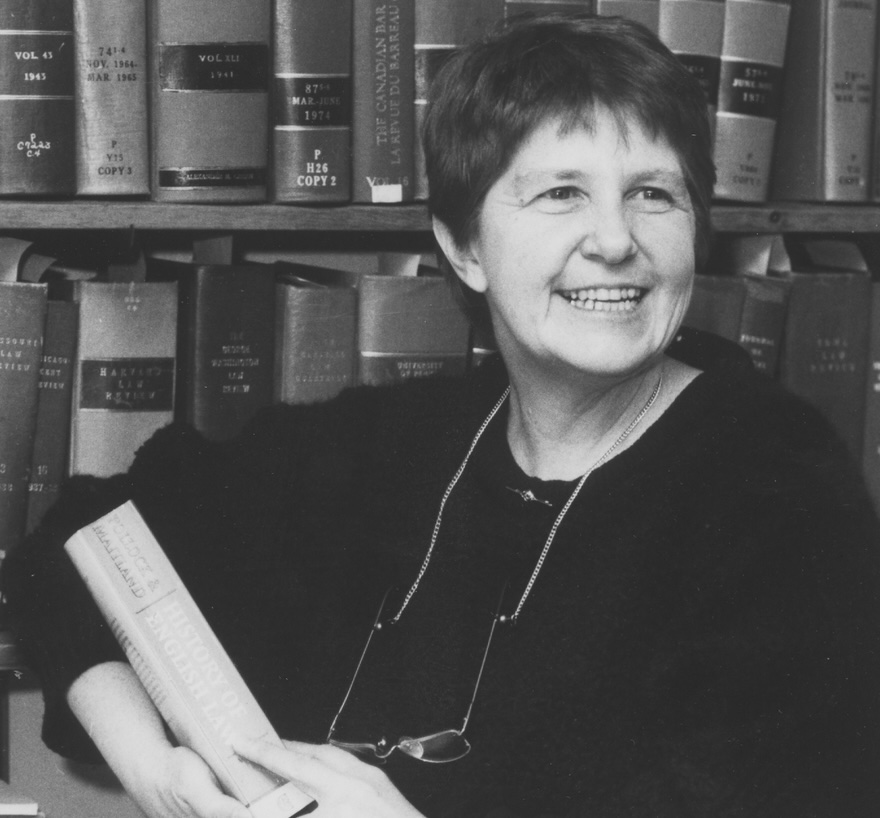
Barbara Aronstein Black died at age 92 in early January 2026. She was the first woman president of ASLH and the first woman dean of an ivy-league law school, at Columbia. Black’s tenure in both overlapped significantly, as her presidency of ASLH lasted four years (which was standard for the era), from 1985-89; the deanship from 1986-91. Both positions were milestones, each a significant boost for the field of legal history and a boon for women in the field. At ASLH, for example, Black’s presidency has been followed by other women, including our current president Mitra Sharafi, who followed Barbara Welke and will in turn be succeeded by Michelle McKinley as the eighth, ninth and tenth women presidents. Black’s presidency marked a turning point that changed the course of the society, especially in light of its almost entirely male early composition. Two years after its creation in 1956, for instance, the ASLH had just three female members (all law librarians) out of almost one hundred members.[1]
Black’s leadership opened doors – those who have witnessed the decades since she took on the responsibilities of governing the society and the law school are beneficiaries of her willingness to serve and to be the first woman in both positions. She also brought good humor and insight to her work and her advice to other women. “Barbara paved the way for women in the profession at a time when she had very few female peers,” said Professor Gillian Lester, the second woman dean at Columbia, now Alphonse Fletcher Jr. Professor. “She was a fixture of the Columbia community for decades, and I will always remember how she welcomed me with her gentle guidance, wisdom, and irrepressible wit.”[2]
Black’s career as a student of legal thought began with her training at Columbia Law School (Class of 1955), where she found herself fascinated with legal theory as well as legal agreements. Eventually, she taught contracts to decades of first year law students; remarking that every legal historian knows they must make themselves useful, and that she had always been interested in legal agreements. One of her classic essay questions was “what is a contract?” She reveled in the breadth and variety of answers she received. But her primary commitment as a scholar was to legal history, particularly in the American colonial period and with an eye to the authority of judges and the effects of judicial decisions on political life. When she returned to graduate training just a decade after completing law school, she became one of the earliest joint JD-PhD scholars in the field. She began a PhD program in history at Yale in 1965, advised by Edmund Morgan. She taught undergraduate classes as she worked on her dissertation, “The Judicial Power and the General Court in Early Massachusetts,” which she defended in 1975.
Just one year later, Black published her inaugural and most influential article, which expanded on her dissertation and was timed to coincide with the 200th anniversary of the Declaration of Independence. She described her growing dedication to the field of legal history. “I joined the history faculty [in] 1976,” she explained, adding that “at this time, I was beginning to move toward engagement with the legal history community. I became a member of [ASLH], which has been an enormously important institution in my life. And, through that society, I met my colleagues in the field…[which] at that moment was simply burgeoning, really taking off.”[3] Her article was published in a law review, a sign of her engagement with lawyers and legal history. The article form, of course, was for decades the single most important publication for law professors.
“The Constitution of Empire: The Case for the Colonists,” published in the University of Pennsylvania Law Review, explored the growing conflict between higher law and Parliamentary supremacy in Britain and its empire in the seventeenth and eighteenth centuries, and the role of that conflict in the American Revolution. Deploying both extensive historical analysis and the development of doctrine in the years leading up to the American Revolution, she concluded that the colonists had a point: Parliament’s imposition of “taxation without representation” was based on a convenient supremacy theory cooked up in the mid-eighteenth century to retrofit an otherwise dubious extension of Parliamentary authority.
This article brought both notice and praise to Black. As she modestly put it, “in 1976, I published an article which has been a somewhat important article, is well known and has been frequently cited.”[4] After turning down a tenure track offer at the University of Chicago, Black moved to Yale Law School as an associate professor in 1979. In the early 1980s, Columbia Law School made her a visiting offer, which she accepted, returning to New York for the spring semester in early 1984. In a rapidly unfolding competition between Yale and Columbia law schools, Yale offered Black a professorship with tenure. Within a week, Columbia countered with the offer 0f a chair as well as tenure – the George Welwood Murray Professor of Legal History. “When I finally had to make the decision,” Black recalled, “I think the answer really was New York…. I was a New Yorker; I never wanted to leave this place.”[5]
Black had a wonderful time at Columbia for a year, she said. In 1985, she became the ASLH president, testimony to her importance in the field and a most welcome chance to strengthen women’s place in the society and give back to those who had welcomed her so cordially. Then, another major change – both an honor and a challenge – emerged when Columbia’s Dean Benno Schmidt was named president of Yale in 1986. Black was chosen as his replacement, a consensus candidate whose appointment as dean would be “big news.” Indeed, her appointment made headlines nationally, a spotlight that she had never sought, but that she understood was a boost for the law school and women’s careers in academia. As she put it, she accepted the deanship knowing that “this would give encouragement to a lot of people out there.”[6]
Black applied herself to the demanding duties of a dean and ASLH president with focus and commitment. She hired feminist theorists Martha Fineman, Patricia Williams, and Kimberle Crenshaw, for example, noting that her recruitment strategy had the “extra something” that produced results. As one of her colleagues put it, “diversification of the faculty was [a] paramount [concern],” because the much greater diversity in the student body had not been reflected in their professors.[7]
Legal historian Daniel Ernst wrote of Black’s influence: “She was president of the [ASLH] … when I joined the scholarly discipline of legal history. She was so gracious to a new entrant and so wise and wryly intelligent that I knew I wanted to be a member of any club that would have her as its leader.” Another observer credited Black with broadening the goals of the society by using her presidency “to further integrate legal history with broader historical and academic studies while building a robust foundation for future scholars.”[8]
During this demanding period, Black also published a second article, which built on the first. “An Astonishing Political Innovation: The Origins of Judicial Review,” was published in 1988 in the University of Pittsburgh Law Reviewand written as part of the U.S. Constitution’s bicentennial. This piece focused on judicial review and reached similar conclusions about Parliament and its pretensions. Black pointed out that the great English legal theorist and judge Edward Coke, especially in Doctor Bonham’s Case (1610), invoked a “higher law” that rested on common right, reason, and natural equity as the ultimate guide and standard for English law. By contrast, Blackstone’s Commentaries on the Common Law, published in 1765, denied Coke’s central premise and claimed that Parliament’s supremacy was boundless and beyond challenge. American lawyers and politicians, who were “weaned on Coke,” as Black put it, committed themselves to “popular” (rather than legislative) supremacy, which they later enshrined in the Constitution. At the same time, they exhibited an unprecedented faith in the rule of law. Judicial review under the U.S. constitution checked the power of the legislature, she argued, in ways that mirrored Coke’s invocation of a protective higher law based on common reason. The “astonishing innovation” that she referred to in the title was not just that the founders entertained such ideas, but that they acted upon them. The result was, as Black put it, “the reason that the world celebrates 1787 with us today.”
Black was also interested in other modern milestones, several of which she had witnessed. She dove into the history of Columbia Law School, writing about the student movement that produced the Columbia Law Review as it reached 100 years of publication, the 75th anniversary of the admittance of women to the school, the careers of talented colleagues and the death of friends on the faculty, and more. She explored these histories with the skill of a writer who amused as well as informed her readers.
Black’s trademark modesty and good will, as well as her deep commitment to encouraging early career scholars, have become a legacy at ASLH. Even as the field has grown and expanded, the Society has focused on collegiality and support, as well as fine scholarship. We remain grateful for Barbara Black’s leadership and will miss her joie de vivre.
Sarah Barringer Gordon
[1] See The Legal Historian (1958), 28. https://aslh.net/wp-content/uploads/2021/05/The-Legal-Historian-No-1-SMU.pdf
[2] https://www.law.columbia.edu/faculty/barbara-black
[3] Oral History, 2006, p.3 https://www.americanbar.org/content/dam/aba/directories/women_trailblazers/black_interview_2.pdf
[4] Ibid.
[5] Oral History, tape 1, 9.
[6] Oral History, tape 2, 3.
[7] NYC Bar Association, “Changing Lives.” https://www.youtube.com/watch?v=21qeXuhOmF0
[8] https://legalhistoryblog.blogspot.com/2026/01/barbara-aronstein-black-1933-2026.html